
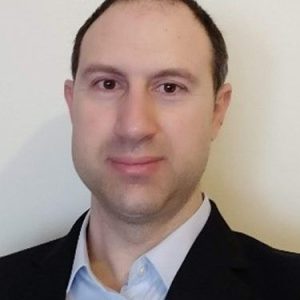
Marine Technology Research Director and Senior Member of the Institute of Electrical and Electronics Engineers (IEEE).
Dr. Ioannis Kyriakides received his BSc degree in Electrical Engineering from Texas A&M University. He received his MSc and PhD degrees from Arizona State University. Throughout his graduate studies, he held a research associate position funded by the Integrated Sensing and Processing program and the Multidisciplinary University Research Initiatives (MURI) of the USA Department of Defence. He received the University Graduate Fellowship of Arizona State University in the final year of his PhD work. His research interests include Bayesian target tracking, sequential Monte Carlo methods and heterogeneous data fusion and heterogeneous sensing asset management. Applications of his research include localization of multiple RF sources, tracking surface vehicles using passive acoustic sensing, tracking multiple targets with constraints in motion and with heterogeneous agile sensing nodes, autonomous vehicle path planning for information acquisition, and identifying suitable areas for maritime activities such as aquaculture and renewable energy facilities. He has been an Associate Professor at the University of Nicosia. He is currently serving as the Marine Technology Research Director at the Cyprus Marine and Maritime Institute (CMMI). Dr. Kyriakides was the Project Coordinator for projects with a total budget of over €14M. Dr. Kyriakides is a Senior Member of the Institute of Electrical and Electronics Engineers (IEEE).
Keynote Speech
Intelligent Coordination and Data Fusion for Maritime Operations" — about fusing heterogeneous sensor data across land, sea, air, and underwater domains to improve situational awareness in maritime environments.
Maritime operations take place in complex and dynamic environments, shaped by both human activity and natural processes. Effective monitoring and response at sea increasingly require the coordination of assets operating across land, sea surface, air, and underwater domains. These assets generate large volumes of data through diverse sensing modalities, yet they often operate under severe constraints in power, bandwidth, communication reliability, and autonomy. This talk will focus on the challenge of fusing heterogeneous data streams into a coherent operational picture and using that information to coordinate diverse platforms with different capabilities and limitations. Through this perspective, the presentation will highlight how intelligent data fusion, adaptive coordination, and cross-domain collaboration can improve situational awareness and support more resilient decision-making in constrained maritime environments.
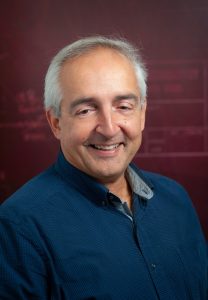
Professor, McKnight Presidential Endowed Professor, Distinguished McKnight University Professor, Director of Graduate Studies for Robotics, Minnesota Robotics Institute Director, Department of Computer Science & Engineering
Prof. Papanikolopoulos (IEEE Fellow, NAI Fellow) received his Ph.D. in Electrical and Computer Engineering from Carnegie Mellon University. His thesis was entitled “Controlled Active Vision” and focused on using computer vision in a controlled fashion to detect, track, and manipulate objects in the environment. His research work has focused on robotics, agriculture, image processing, computer vision, and intelligent transportation systems. He has received numerous honors and awards for his research and contributions. He has been a Distinguished McKnight University Professor at the University of Minnesota since 2007 and has been a McKnight Presidential Endowed Professor in Computer Science since 2016. In 2016, he received the IEEE RAS George Saridis Leadership Award in Robotics and Automation as well as the Center for Transportation Studies Research Partnership Award.
Keynote Speech
View Planning for 3D Reconstruction of Plants
Active vision (AV) has been in the spotlight of robotics research due to its emergence in numerous applications, including agriculture and biomedicine, to name a few. A major AV problem that has gained popularity is the 3D reconstruction of targeted environments from multiple 2D views. While collecting and processing a large number of arbitrarily taken 2D images may become an arduous process in several practical settings, an efficient solution is to seek the optimal placement of available cameras in the 3D space to obtain the necessary visual information from fewer yet more informative images to effectively reconstruct environments of interest. This process, termed as view planning (VP), can be markedly challenged in the presence of noise emerging in the environment, location of the cameras, and/or in the extracted images. We present an efficient and realistic VP pipeline, which aims to optimize the viewpoints of cameras and hence the quality of the 3D reconstruction of a field of row crops without the need for a given mesh model. This is achieved within four steps: (i) an initial flight to obtain a sparse point cloud, (ii) the generation of an initial simple mesh model utilizing the sparse point cloud, (iii) the planning of images via a discrete optimization process, and (iv) a second flight to obtain the final reconstruction. We demonstrate the effectiveness of the proposed VP framework against commonly used baseline methods for agricultural data collection and processing.
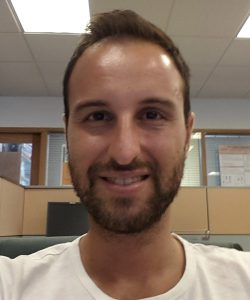
Senior Research Associate KIOS Research and Innovation Center of Excellence, University of Cyprus
Dr. Stelios G. Vrachimis is a Senior Research Associate at the KIOS Research and Innovation Center of Excellence, University of Cyprus. He holds an M.Sc. in Control Systems from Imperial College London and a Ph.D. in Electrical Engineering from the University of Cyprus. His research focuses on smart water systems, using AI-based monitoring, state estimation, fault diagnosis, optimization, control, and digital twins for water distribution and water-quality applications. He has contributed to several national and European projects on smart water resilience, including digital-twin platforms for Cypriot water utilities, leakage diagnosis, contamination detection, and risk-based water-quality management. His work aims to translate advanced research methods into operational decision-support tools for water utilities.
Keynote Speech
From Water Monitoring to Smart Water Resilience using AI and Digital Twins
Water systems are becoming increasingly complex cyber-physical infrastructures, facing growing challenges related to water losses, contamination, energy use, climate extremes, and cybersecurity. This talk will present recent work on the use of Artificial Intelligence and digital twins to move from water monitoring towards smart water resilience. The focus will be on practical applications in water utilities and emergency-response contexts, showing how machine learning, computational intelligence, digital twins, and generative AI tools can support critical tasks such as leak detection, water-quality event detection, contamination-risk assessment, and real-time operational awareness. Examples using multiple sensing technologies, such as satellite data and drones, will be discussed, with emphasis on how they can be integrated for risk-based management of drinking-water networks. The talk will highlight how AI can move beyond offline analytics towards operational decision-support tools that improve the efficiency, safety, reliability, and resilience of water systems.
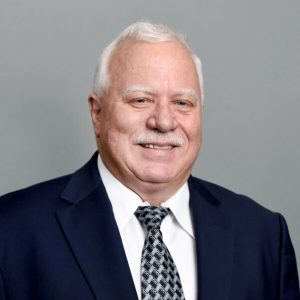
Professor and SenSIP Center Director in the School of Electrical, Computer, and Energy Engineering at Arizona State University (ASU)
Andreas Spanias is Professor in the School of Electrical, Computer, and Energy Engineering at Arizona State University (ASU). He is also the director of the Sensor Signal and Information Processing (SenSIP) center and the founder of the SenSIP industry consortium (also an NSF I/UCRC site). His research interests are in the areas of adaptive signal processing, speech processing, quantum machine learning and sensor systems. He and his student team developed the computer simulation software Java-DSP and its award-winning iPhone/iPad and Android versions. He is author of two textbooks: Audio Processing and Coding by Wiley and DSP; An Interactive Approach (2nd Ed.). He contributed to more than 350 papers, 11 monographs, 21 full US patents, 10 provisional patents and several IP pre-disclosures. He served as Associate Editor of the IEEE Transactions on Signal Processing and as General Co-chair of IEEE ICASSP-99. He also served as the IEEE Signal Processing Vice-President for Conferences. Andreas Spanias is co-recipient of the 2002 IEEE Donald G. Fink paper prize award and was elected Fellow of the IEEE in 2003. He served as Distinguished Lecturer for the IEEE Signal processing society in 2004. He is a series editor for the Morgan and Claypool lecture series (now under Springer) on algorithms and software. He co-authored with his students a paper on Quantum Fourier transforms for signal analysis-synthesis at ICASSP 2023 that received a Top 3% rating certificate. He was also co-author on an SPIE 2023 publication on deep learning that won a Best Paper award. He is currently heading four NSF workforce development projects as a PI. He received the 2018 IEEE Phoenix Chapter award with citation: “For significant innovations and patents in signal processing for sensor systems.” He also received the 2018 IEEE Region 6 Outstanding Educator Award (across 12 states) with citation: “For outstanding research and education contributions in signal processing.” He was elected recently to Senior Member of the National Academy of Inventors (NAI). Andreas Spanias was named Fulbright U.S. Research Scholar and will conduct research in machine learning for energy and other applications at UKIM in Skopje.
Keynote Speech
SenSIP Quantum Machine Learning Algorithms and Applications
The SenSIP Center has established a broad research program in quantum machine learning (QML) with applications spanning healthcare, cybersecurity, and sustainable energy. Recent efforts of PhD students include QML methods for brain tumor detection from MRI, quantum-enhanced histopathological image classification executed on quantum hardware, and hybrid quantum-classical algorithms for credit card fraud detection. SenSIP has also developed QML approaches for photovoltaic (PV) fault detection and classification, improving the reliability of solar energy systems. The seminar will also summarize NSF research experience for undergraduate projects on QML. All these activities integrate quantum feature encoding, variational quantum circuits, and noise-aware optimization while providing research opportunities for undergraduate and graduate students, advancing both practical applications and quantum AI education.